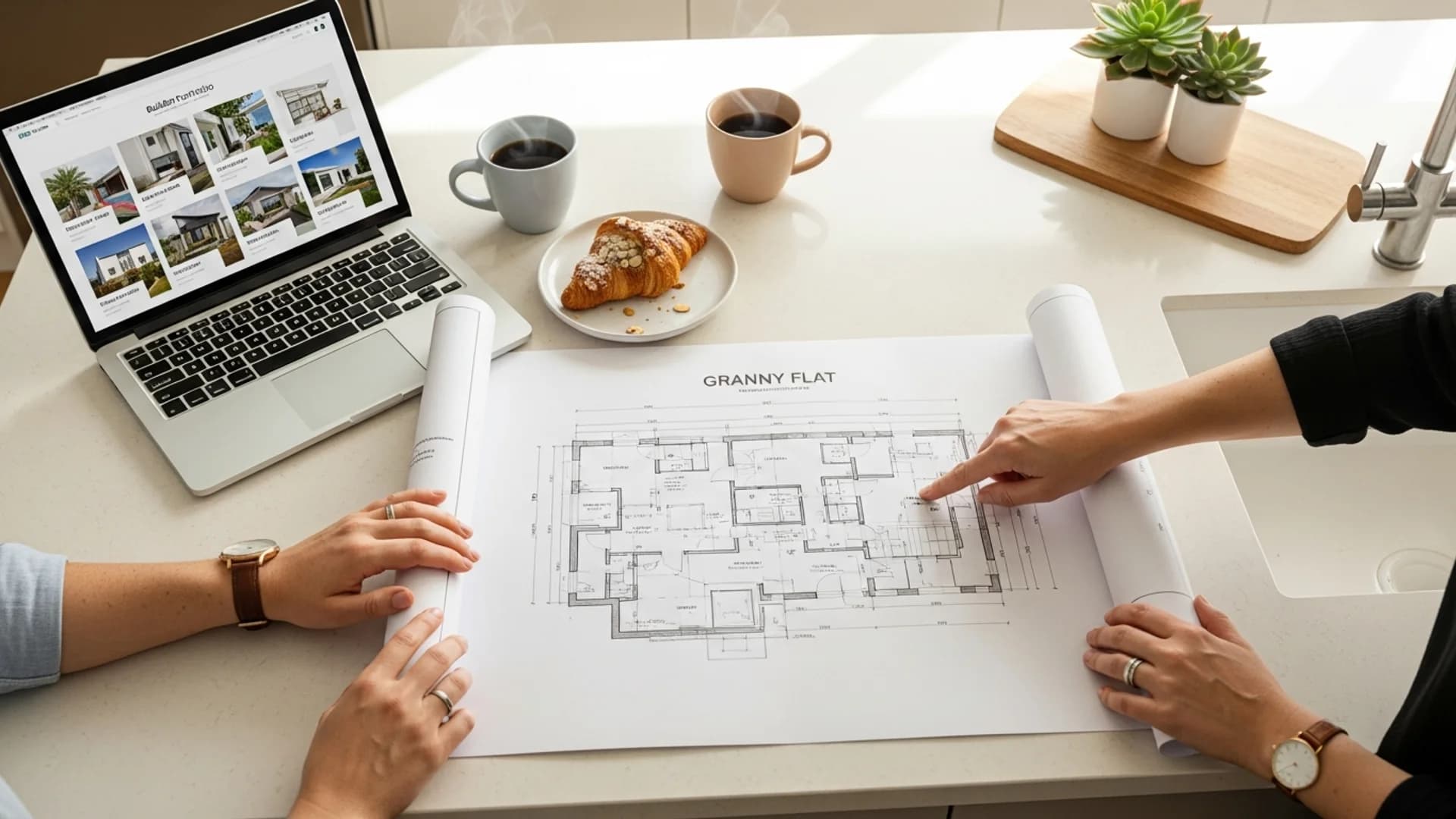
How to Choose a Granny Flat Builder
A practical vetting guide for Australian homeowners — what to verify, what to ask, and what should stop you signing.
What good builder vetting looks like
Licence and insurance come first
Verify the builder's licence on the state register and confirm home warranty insurance is in place for your project — before you discuss design, timelines, or price.
References beat glossy portfolios
Ask for three completed granny flats you can visit or call about. Two past clients on the phone will tell you more than a dozen website photos.
Itemised quotes, not lump sums
Insist on line items for base build, site works, professional fees, and authority charges. A single headline price hides where the margin — or the omission — actually sits.
Contract terms protect you
Fixed price, capped deposit, stage-based progress payments, and a defined defects liability period are non-negotiable on a residential contract over $20,000.
Red flags end the conversation
No fixed-price contract, deposits over 10%, missing ABN or licence number, cash-only discounts, or pressure to sign today are reasons to walk away — regardless of the headline number.
State rules vary — check yours
NSW Fair Trading, the Victorian Building Authority, and the QBCC each run their own licence register and insurance scheme. The thresholds and the paperwork differ by state.
Choose a granny flat builder by verifying three things before you talk about design: their state licence, their home warranty insurance, and at least three completed granny flats you can contact directly. Everything else — quote comparisons, contract terms, red flags — flows from that foundation. A builder who cannot produce those three items in the first conversation is not a builder you should be negotiating with.
Australia has no single national builder register. Each state runs its own licensing scheme, its own insurance threshold, and its own dispute resolution body. The vetting process on this page works nationally, but the specific checks and the thresholds you are verifying change depending on where you build.
This guide is written for homeowners comparing two or three builders on a $120,000 to $250,000 turnkey project. If you are considering an owner-builder pathway, the checks shift — you become the principal, and the compliance burden lands on you. For everyone else, the steps below are the minimum due diligence before signing a contract.

Start with licence verification — always
Licence registration is the one fact a prospective builder cannot fudge. Every Australian state publishes an online register where you can search a name or ABN and see current licence status, the scope of work permitted, and any disciplinary history.
- NSW: service.nsw.gov.au — "Check a builder or tradesperson licence"
- VIC: vba.vic.gov.au — "Find a practitioner"
- QLD: my.qbcc.qld.gov.au — "Licensee register"
Search the company name and the individual builder's name separately. A common pattern with unscrupulous operators is that the company trades under a director who is not personally licensed — or whose licence has been suspended. If the name on the quote does not match the name on the register, ask why.
Membership of an industry body — HIA, Master Builders, or a state chapter — is a signal of engagement, not a consumer guarantee. Check the licence first. Industry body logos second.
Confirm home warranty insurance is actually in place
Home warranty insurance (the precise name varies by state) protects you if the builder becomes insolvent, dies, or disappears before the job is finished or before the defects period expires. Alongside granny flat rules and planning approval, it is the most important consumer protection on a residential building contract.
The thresholds and names:
- NSW: Home Building Compensation (HBC) is required for any residential works over $20,000. Every granny flat project qualifies.
- VIC: Domestic Building Insurance (DBI) is required for works over $16,000.
- QLD: Home Warranty Insurance (HWI) through the QBCC scheme is required for works over $3,300 — effectively every granny flat build in Queensland.
Ask the builder to provide a certificate of insurance for your specific project before you pay a deposit. The certificate is issued once the builder lodges your contract with the insurer. If the builder tells you insurance will be sorted "after" you sign, that is a warning sign, not a scheduling detail.
Request at least three past project references
Ask for three completed granny flats you can visit or call about. A legitimate builder will have this list ready — they know references close deals. Insist on granny flats specifically, not full house builds, because the site-cost dynamics are different on a 60sqm secondary dwelling.
When you call references, ask three questions:
- How closely did the final price match the original quote?
- How did the builder handle the first major problem on site?
- Would you use them again?
The second question matters most. Every build has at least one problem — a soil test surprise, a council request for information, a delayed product. A good builder tells you about the problem, offers options with prices, and moves on. A bad builder disappears, blames the owner, or issues surprise variations that arrive with an invoice attached.
Compare itemised quotes, not lump-sum totals
Three granny flat builders will quote your project three different ways. Some will hand you a single figure. Others will break out the base build package, the site costs, the professional fees, and the authority charges. Only the itemised quote lets you compare builders fairly.
Insist on line items for the four cost buckets every granny flat project has to pay for:
- Base build package — the structure and internal fit-out
- Site works — earthworks, slab, retaining walls, tree removal, service runs
- Professional and approval fees — design, engineering, BASIX (NSW), CDC or DA lodgement
- Authority and utility charges — sewer and water compliance, electrical upgrades, infrastructure charges where applicable
If one builder's quote is $40,000 cheaper than another's, the difference is almost always sitting in one of these four buckets. Without line items, you cannot tell which bucket — or whether you are looking at a better deal or at items that have simply been left out to make the headline number look competitive.
For a deeper walkthrough of what drives these numbers, see the granny flat building costs breakdown and the guide to published granny flat prices — both explain how builder pricing is put together and what is typically excluded.
Check council liaison is included in the scope
A turnkey build should include everything from site assessment to handover. Council lodgement — a CDC in NSW, a building permit in Victoria, or accepted development lodgement in Queensland — should not be something you do yourself unless you are on an owner-builder pathway. If the builder's scope excludes council lodgement without reducing the price accordingly, that is a margin pad and a warning sign.
For NSW projects where the CDC approval pathway is available, confirm the builder has a preferred private certifier they work with and that the quoted fee covers lodgement and any certifier requests for information. For Victorian projects, confirm the builder handles the building permit application through a registered building surveyor. In Queensland, ask whether the project falls under accepted development for the specific council or whether a DA is required — the answer materially changes the timeline.
Review the contract payment schedule line by line
Deposit caps exist precisely because large upfront payments are the most common way consumers lose money on residential building projects. In NSW, the law limits deposits on residential building contracts over $20,000 to 10% of the contract price or $20,000, whichever is less. A builder asking for 30% up-front on a granny flat is not "just how it is done" — it is breaching the consumer protection that exists on paper specifically to stop that behaviour.
A reasonable progress payment schedule looks like this:
- Deposit on signing: up to 10% (capped in NSW)
- Base stage (slab complete): 10–15%
- Frame stage (framing complete): 20–25%
- Enclosed stage (roof, windows, external cladding): 20–25%
- Fixing stage (internal fit-out, tiling, painting): 20–25%
- Practical completion: 5–10%
Never pay ahead of stage. If the builder asks for a frame payment before the frame is up, decline politely and point to the contract. Stage payments are not a formality — they are the mechanism that keeps the builder honest, because they do not get the next tranche until the work is actually done.
Confirm the defects liability period
The defects liability period is the window after practical completion during which the builder must return to fix issues at no charge. Six months is the typical minimum on a residential contract; twelve months is better. In NSW, the statutory warranty period is 6 years for major defects and 2 years for other defects — the defects liability period in the contract sits in addition to those statutory warranties, not as a replacement.
Make sure the contract specifies:
- The length of the defects liability period
- How defects are reported (in writing, within what timeframe)
- Response time for major defects (72 hours for anything affecting habitability is reasonable)
- Final payment withheld until defects are resolved
Red flags — when to walk away
Some behaviours should end a builder conversation immediately, regardless of the quote price or how charming the sales rep was.
- No fixed-price contract. Cost-plus arrangements on a residential granny flat are almost always a worse deal for you than a fixed price with a realistic contingency.
- Demands for a large upfront payment. Anything over 10% breaches NSW law and is questionable practice in every state.
- No ABN or licence number on the quote. Both should be printed on every page of every document you receive.
- Pressure to sign today. "This price is only valid this week" is a classic closing technique used on people who do not have time to verify.
- Cash-only discount offers. They void warranty insurance and break the consumer protection chain entirely.
- Verbal promises that do not make it into the written contract. If it is not in writing, it does not exist. Get every inclusion, every exclusion, and every allowance into the contract before you sign.
Questions to ask at the quoting stage
Print this list. Take it to every quoting meeting:
- What is your current licence number, and where can I verify it?
- Will you provide a certificate of home warranty insurance for my project before I pay a deposit?
- Can I visit a completed granny flat you built in the last 12 months?
- Is the quote itemised across base build, site works, professional fees, and authority charges?
- What site costs are excluded — retaining walls, tree removal, service connection runs?
- Who lodges the CDC, DA, building permit, or accepted development paperwork?
- What is the deposit, and what are the progress payment stages?
- How long is the defects liability period, and how are defects reported?
- What happens if the job runs late — is there a liquidated damages clause?
- Can I have 48 hours to review the contract with a solicitor before signing?
If a builder hesitates on question ten — the solicitor review — that is a quiet red flag on its own. Legitimate builders expect contract review. It is a normal part of every significant construction project.
What the vetting process tells you about the builder
By the time you have worked through licence, insurance, references, itemised quote, and contract review, you already know whether this is a builder you want on your property for the next four to six months. These checks are not a bureaucratic hurdle — they are the first real test of how the builder will handle your project when something inevitably goes wrong.
A builder who walks you through licence and insurance without prompting, volunteers references before being asked, and itemises every cost bucket by default has already told you, through their behaviour, what working with them will be like. A builder who resents the questions has told you exactly the same thing.
GrannyFlatGuide is an independent resource — our about page explains how we stay that way. We do not accept payment from builders in exchange for directory placement or favourable coverage. Use the checklist above with any builder you are considering, including ones we connect you with.
A note on scope
This page is general consumer guidance, not legal advice. Building contracts are enforceable agreements with real financial consequences. For contracts over $100,000 — which describes most turnkey granny flat projects — a one-hour review by a building-and-construction solicitor typically costs $300–$600 and often saves many times that in variation disputes and scope disagreements later. GrannyFlatGuide does not provide legal, planning, or building advice. Verify licence and insurance details directly with the relevant state regulator before making decisions.
Granny flat builders in Australia
Browse profiles, compare service areas, and check reviews.

Garden Studios
★ 5.0 (63 reviews)
View profile →

Perway Ecopods
★ 5.0 (43 reviews)
Perth-based home renovation and construction company offering custom builds with transparent service.
View profile →

Out-Back Portable Buildings
★ 5.0 (25 reviews)
Custom-made, pre-fabricated transportable homes including granny flats, offices, and portable buildings.
View profile →

Adams Cabins
★ 5.0 (20 reviews)
Family-owned cabin builders specializing in log cabins, granny flats, and tiny homes in SE Queensland.
View profile →

ATN Constructions
★ 5.0 (18 reviews)
View profile →

Dare Constructions
★ 5.0 (16 reviews)
Steel frame construction specialist including granny flats, carports, sheds across Newcastle, Hunter Valley, and Sydney.
View profile →
GrannyFlatGuide is a comparison platform. Companies shown are filtered by relevance to this page. Listing does not imply endorsement. GrannyFlatGuide may receive a referral fee when you request quotes.
Put this into action
Check your property’s zoning and approval pathway, then connect with verified builders when you’re ready.
What can you build on your property?
Enter your address and we'll check your zoning, overlays, and what's possible on your block.
We use your address to check council zoning and planning rules — not stored until you choose to continue.
Choose a granny flat builder by verifying three things before you talk about design: their state licence, their home warranty insurance, and at least three completed granny flats you can contact directly. Everything else — quote comparisons, contract terms, red flags — flows from that foundation. A builder who cannot produce those three items in the first conversation is not a builder you should be negotiating with.
Australia has no single national builder register. Each state runs its own licensing scheme, its own insurance threshold, and its own dispute resolution body. The vetting process on this page works nationally, but the specific checks and the thresholds you are verifying change depending on where you build.
This guide is written for homeowners comparing two or three builders on a $120,000 to $250,000 turnkey project. If you are considering an owner-builder pathway, the checks shift — you become the principal, and the compliance burden lands on you. For everyone else, the steps below are the minimum due diligence before signing a contract.
Start with licence verification — always
Licence registration is the one fact a prospective builder cannot fudge. Every Australian state publishes an online register where you can search a name or ABN and see current licence status, the scope of work permitted, and any disciplinary history.
- NSW: service.nsw.gov.au — "Check a builder or tradesperson licence"
- VIC: vba.vic.gov.au — "Find a practitioner"
- QLD: my.qbcc.qld.gov.au — "Licensee register"
Search the company name and the individual builder's name separately. A common pattern with unscrupulous operators is that the company trades under a director who is not personally licensed — or whose licence has been suspended. If the name on the quote does not match the name on the register, ask why.
Membership of an industry body — HIA, Master Builders, or a state chapter — is a signal of engagement, not a consumer guarantee. Check the licence first. Industry body logos second.
Confirm home warranty insurance is actually in place
Home warranty insurance (the precise name varies by state) protects you if the builder becomes insolvent, dies, or disappears before the job is finished or before the defects period expires. Alongside granny flat rules and planning approval, it is the most important consumer protection on a residential building contract.
The thresholds and names:
- NSW: Home Building Compensation (HBC) is required for any residential works over $20,000. Every granny flat project qualifies.
- VIC: Domestic Building Insurance (DBI) is required for works over $16,000.
- QLD: Home Warranty Insurance (HWI) through the QBCC scheme is required for works over $3,300 — effectively every granny flat build in Queensland.
Ask the builder to provide a certificate of insurance for your specific project before you pay a deposit. The certificate is issued once the builder lodges your contract with the insurer. If the builder tells you insurance will be sorted "after" you sign, that is a warning sign, not a scheduling detail.
Request at least three past project references
Ask for three completed granny flats you can visit or call about. A legitimate builder will have this list ready — they know references close deals. Insist on granny flats specifically, not full house builds, because the site-cost dynamics are different on a 60sqm secondary dwelling.
When you call references, ask three questions:
- How closely did the final price match the original quote?
- How did the builder handle the first major problem on site?
- Would you use them again?
The second question matters most. Every build has at least one problem — a soil test surprise, a council request for information, a delayed product. A good builder tells you about the problem, offers options with prices, and moves on. A bad builder disappears, blames the owner, or issues surprise variations that arrive with an invoice attached.
Compare itemised quotes, not lump-sum totals
Three granny flat builders will quote your project three different ways. Some will hand you a single figure. Others will break out the base build package, the site costs, the professional fees, and the authority charges. Only the itemised quote lets you compare builders fairly.
Insist on line items for the four cost buckets every granny flat project has to pay for:
- Base build package — the structure and internal fit-out
- Site works — earthworks, slab, retaining walls, tree removal, service runs
- Professional and approval fees — design, engineering, BASIX (NSW), CDC or DA lodgement
- Authority and utility charges — sewer and water compliance, electrical upgrades, infrastructure charges where applicable
If one builder's quote is $40,000 cheaper than another's, the difference is almost always sitting in one of these four buckets. Without line items, you cannot tell which bucket — or whether you are looking at a better deal or at items that have simply been left out to make the headline number look competitive.
For a deeper walkthrough of what drives these numbers, see the granny flat building costs breakdown and the guide to published granny flat prices — both explain how builder pricing is put together and what is typically excluded.
Check council liaison is included in the scope
A turnkey build should include everything from site assessment to handover. Council lodgement — a CDC in NSW, a building permit in Victoria, or accepted development lodgement in Queensland — should not be something you do yourself unless you are on an owner-builder pathway. If the builder's scope excludes council lodgement without reducing the price accordingly, that is a margin pad and a warning sign.
For NSW projects where the CDC approval pathway is available, confirm the builder has a preferred private certifier they work with and that the quoted fee covers lodgement and any certifier requests for information. For Victorian projects, confirm the builder handles the building permit application through a registered building surveyor. In Queensland, ask whether the project falls under accepted development for the specific council or whether a DA is required — the answer materially changes the timeline.
Review the contract payment schedule line by line
Deposit caps exist precisely because large upfront payments are the most common way consumers lose money on residential building projects. In NSW, the law limits deposits on residential building contracts over $20,000 to 10% of the contract price or $20,000, whichever is less. A builder asking for 30% up-front on a granny flat is not "just how it is done" — it is breaching the consumer protection that exists on paper specifically to stop that behaviour.
A reasonable progress payment schedule looks like this:
- Deposit on signing: up to 10% (capped in NSW)
- Base stage (slab complete): 10–15%
- Frame stage (framing complete): 20–25%
- Enclosed stage (roof, windows, external cladding): 20–25%
- Fixing stage (internal fit-out, tiling, painting): 20–25%
- Practical completion: 5–10%
Never pay ahead of stage. If the builder asks for a frame payment before the frame is up, decline politely and point to the contract. Stage payments are not a formality — they are the mechanism that keeps the builder honest, because they do not get the next tranche until the work is actually done.
Confirm the defects liability period
The defects liability period is the window after practical completion during which the builder must return to fix issues at no charge. Six months is the typical minimum on a residential contract; twelve months is better. In NSW, the statutory warranty period is 6 years for major defects and 2 years for other defects — the defects liability period in the contract sits in addition to those statutory warranties, not as a replacement.
Make sure the contract specifies:
- The length of the defects liability period
- How defects are reported (in writing, within what timeframe)
- Response time for major defects (72 hours for anything affecting habitability is reasonable)
- Final payment withheld until defects are resolved
Red flags — when to walk away
Some behaviours should end a builder conversation immediately, regardless of the quote price or how charming the sales rep was.
- No fixed-price contract. Cost-plus arrangements on a residential granny flat are almost always a worse deal for you than a fixed price with a realistic contingency.
- Demands for a large upfront payment. Anything over 10% breaches NSW law and is questionable practice in every state.
- No ABN or licence number on the quote. Both should be printed on every page of every document you receive.
- Pressure to sign today. "This price is only valid this week" is a classic closing technique used on people who do not have time to verify.
- Cash-only discount offers. They void warranty insurance and break the consumer protection chain entirely.
- Verbal promises that do not make it into the written contract. If it is not in writing, it does not exist. Get every inclusion, every exclusion, and every allowance into the contract before you sign.
Questions to ask at the quoting stage
Print this list. Take it to every quoting meeting:
- What is your current licence number, and where can I verify it?
- Will you provide a certificate of home warranty insurance for my project before I pay a deposit?
- Can I visit a completed granny flat you built in the last 12 months?
- Is the quote itemised across base build, site works, professional fees, and authority charges?
- What site costs are excluded — retaining walls, tree removal, service connection runs?
- Who lodges the CDC, DA, building permit, or accepted development paperwork?
- What is the deposit, and what are the progress payment stages?
- How long is the defects liability period, and how are defects reported?
- What happens if the job runs late — is there a liquidated damages clause?
- Can I have 48 hours to review the contract with a solicitor before signing?
If a builder hesitates on question ten — the solicitor review — that is a quiet red flag on its own. Legitimate builders expect contract review. It is a normal part of every significant construction project.
What the vetting process tells you about the builder
By the time you have worked through licence, insurance, references, itemised quote, and contract review, you already know whether this is a builder you want on your property for the next four to six months. These checks are not a bureaucratic hurdle — they are the first real test of how the builder will handle your project when something inevitably goes wrong.
A builder who walks you through licence and insurance without prompting, volunteers references before being asked, and itemises every cost bucket by default has already told you, through their behaviour, what working with them will be like. A builder who resents the questions has told you exactly the same thing.
GrannyFlatGuide is an independent resource — our about page explains how we stay that way. We do not accept payment from builders in exchange for directory placement or favourable coverage. Use the checklist above with any builder you are considering, including ones we connect you with.
A note on scope
This page is general consumer guidance, not legal advice. Building contracts are enforceable agreements with real financial consequences. For contracts over $100,000 — which describes most turnkey granny flat projects — a one-hour review by a building-and-construction solicitor typically costs $300–$600 and often saves many times that in variation disputes and scope disagreements later. GrannyFlatGuide does not provide legal, planning, or building advice. Verify licence and insurance details directly with the relevant state regulator before making decisions.
Granny flat builders in Australia
Browse profiles, compare service areas, and check reviews.
Garden Studios
★ 5.0 (63 reviews)
View profile →
Perway Ecopods
★ 5.0 (43 reviews)
Perth-based home renovation and construction company offering custom builds with transparent service.
View profile →
Out-Back Portable Buildings
★ 5.0 (25 reviews)
Custom-made, pre-fabricated transportable homes including granny flats, offices, and portable buildings.
View profile →
Adams Cabins
★ 5.0 (20 reviews)
Family-owned cabin builders specializing in log cabins, granny flats, and tiny homes in SE Queensland.
View profile →
ATN Constructions
★ 5.0 (18 reviews)
View profile →
Dare Constructions
★ 5.0 (16 reviews)
Steel frame construction specialist including granny flats, carports, sheds across Newcastle, Hunter Valley, and Sydney.
View profile →
GrannyFlatGuide is a comparison platform. Companies shown are filtered by relevance to this page. Listing does not imply endorsement. GrannyFlatGuide may receive a referral fee when you request quotes.
Put this into action
Check your property’s zoning and approval pathway, then connect with verified builders when you’re ready.
What can you build on your property?
Enter your address and we'll check your zoning, overlays, and what's possible on your block.
We use your address to check council zoning and planning rules — not stored until you choose to continue.
Frequently asked questions
Search the state regulator's online register by company name and by the individual builder's name. In NSW, use service.nsw.gov.au's builder licence check. In Victoria, use the Victorian Building Authority's Find a Practitioner tool at vba.vic.gov.au. In Queensland, use the QBCC licensee register at my.qbcc.qld.gov.au. If the name on the quote does not match the name on the register, ask the builder to explain before going any further.
At a minimum, home warranty insurance for your specific project (HBC in NSW for works over $20,000, DBI in Victoria for works over $16,000, or HWI in Queensland for works over $3,300). The builder should also hold public liability insurance of at least $20 million and workers' compensation cover for any employees on site. Ask for a certificate of insurance for your project before you pay a deposit — not after.
Three is the minimum for a fair comparison. Two quotes leaves you with no way to tell whether either is reasonable. Four or more starts to waste both your time and the builders' — and legitimate builders begin to disengage once they realise they are one of five or six. Ask all three builders for itemised quotes so you can compare the four cost buckets (base build, site works, professional fees, authority charges) line by line.
In NSW, the law caps deposits on residential building contracts over $20,000 at 10% of the contract price or $20,000, whichever is less. Victoria and Queensland do not have the same statutory cap but industry practice is similar — anything over 10% on a $150,000 granny flat should be questioned. A builder who demands 30% up-front is not following standard practice, regardless of what they tell you.
No. Cash-only arrangements void home warranty insurance, break the GST chain, and leave you with no consumer protection if anything goes wrong. The "discount" is almost always smaller than the value of the warranty insurance and statutory warranties you give up. Any builder who proposes a cash-only deal is telling you something important about how they run their business — believe them.
Six months is the typical minimum on a residential contract, and 12 months is better. This is the window after practical completion during which the builder must return to fix defects at no charge. In NSW, statutory warranties run in parallel — 6 years for major defects and 2 years for other defects under the Home Building Act. The contract's defects liability period sits in addition to these statutory warranties, not as a replacement.
Turnkey should cover design, approvals, base build, site works, and handover — but the term is not legally defined, and inclusions vary. Always check whether the quote includes retaining walls, tree removal, long service runs, driveway, fencing, landscaping, and authority utility fees. These are the items most commonly excluded from a 'turnkey' figure, and together they can add $15,000 to $40,000 on a sloping or hard-to-access site.
Yes. The state regulator's licence register shows disciplinary history, current suspensions, and cancellations. In NSW, the service.nsw.gov.au licence check includes disciplinary action. In Victoria, the VBA's practitioner search flags disciplinary outcomes. In Queensland, QBCC publishes licence status and complaint outcomes. Google the builder's name alongside the word 'tribunal' — NCAT (NSW), VCAT (Victoria), and QCAT (Queensland) decisions are publicly searchable.
Not automatically. The cheapest quote is often cheapest because something has been left out of scope — most commonly site costs, service connections, council fees, or contingency. Before deciding on price, line up the three quotes against the four cost buckets and check that each builder has included the same items in each bucket. The cheapest genuinely like-for-like quote from a licensed, insured builder with good references is the right choice. The cheapest headline number on its own is not.
Yes. A fixed-price contract transfers most of the cost-overrun risk to the builder, which is where it belongs on a project where the builder controls the schedule, the trades, and the supply chain. Cost-plus contracts — where you pay actual costs plus a margin — are appropriate for unusual custom projects but almost never for a standard granny flat build. Insist on a fixed price with a clearly listed set of provisional sums for any items that genuinely cannot be priced until site works begin.
Allow at least 48 hours. For contracts over $100,000 — which describes most turnkey granny flat projects — a one-hour review by a building-and-construction solicitor typically costs $300–$600 and regularly identifies variation clauses, payment schedule issues, or exclusion language that a homeowner would not catch. A builder who will not allow 48 hours for contract review is telling you the contract is the pressure point, which is exactly the reason to review it carefully.
Related guides
Guide
Granny Flat Rules Victoria 2026 — Planning & Building Guide
Victoria's granny flat rules explained — planning permits, 60sqm cap, building requirements, DPU changes, and how the 2023-2026 reforms affect your build.
Guide
Granny Flat Rules NSW — CDC, Setbacks & Approvals (2026)
NSW granny flat rules explained — lot size minimums, CDC vs DA pathways, setback distances and BASIX requirements under SEPP (Housing) 2021.
Cost guide
2 Bedroom Granny Flat Cost — Pricing by Build Type (2026)
A 2-bedroom granny flat costs $114,000–$237,000 GST-inclusive in Australia. See pricing by build type (kit, prefab, custom), state, and finish level.
Cost guide
Granny Flat Prices in Australia — Real Builder Pricing Compared (2026)
Compare real granny flat prices across budget prefab, mid-range custom, and premium turnkey tiers. See what the 'from' price includes and what you'll actually pay in 2026.
Ready to compare granny flat builders?
Get up to three free quotes from licensed, insured Australian granny flat builders. No pressure, no lock-in.
Join 1,000+ Australians who've used GrannyFlatGuide to research their granny flat project
Get free quotes