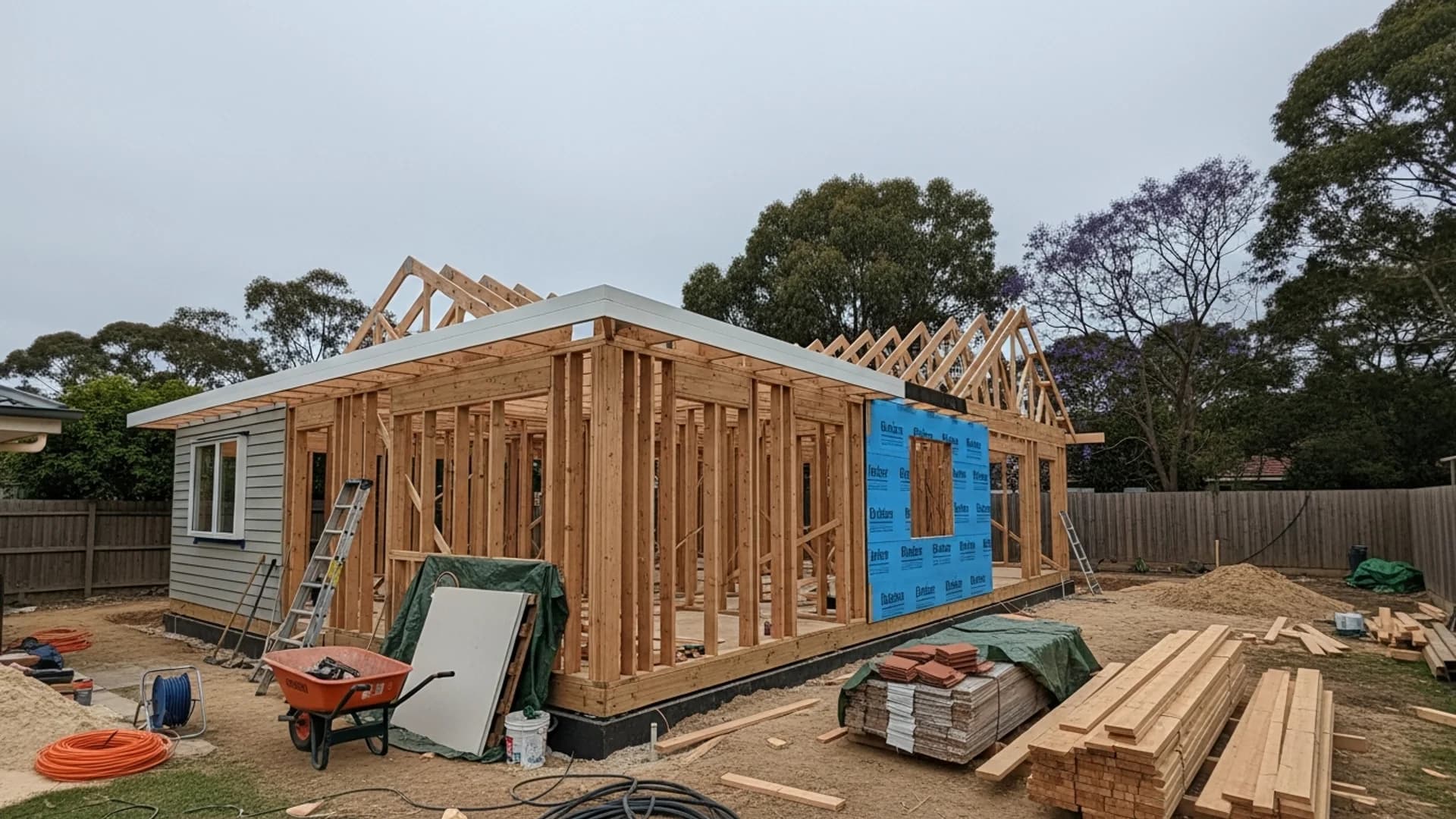
Granny Flat Building Costs: What You'll Really Pay in 2026
Honest cost ranges for every build type — from kit homes to custom turnkey builds — plus the site works, approvals, and connection fees that builders don't always mention upfront.
Cost at a Glance
Studio granny flat
$80,000 – $150,000 for a compact self-contained studio under 40sqm. The most affordable option for singles, couples, or Airbnb-focused builds.
1-bedroom granny flat
$100,000 – $200,000 for a separate bedroom, living area, kitchen, and bathroom. The most common granny flat type built in Australia.
2-bedroom granny flat
$130,000 – $280,000 for two bedrooms, typically 50–60sqm. Higher rental yield potential and suited to family accommodation.
Kit home (kit only)
$40,000 – $120,000 for pre-cut materials delivered to site. Remember: a $40K kit is not a $40K granny flat — slab, labour, approvals, and fit-out are all additional.
The single most common question we hear is: how much does a granny flat actually cost? Not the "from $120K" you see on a builder's homepage — the real, all-in number that includes everything from the slab to the final council inspection.
The honest answer is that a typical turnkey granny flat in Australia costs between $120,000 and $250,000, depending on size, build type, site conditions, and your state's approval requirements. But that range is wide for a reason — your final cost depends on four distinct cost buckets, and the build itself is only one of them.
This guide breaks down granny flat building costs across every build type, explains where your money actually goes, and gives you the detail you need to budget realistically. All cost figures are ex GST and based on industry research current as of Q2 2026.
Understanding Granny Flat Building Costs
The Four Cost Buckets
Every granny flat project has four cost buckets. Builders typically quote on the first one — the build itself — but buckets two through four can add $25,000 to $80,000 or more to your total project cost. Understanding all four is the difference between a realistic budget and a nasty surprise.
Bucket 1: The Build (55–65% of total cost)
This is what most builders quote — the slab, frame, cladding, roofing, internal fit-out, kitchen, bathroom, flooring, and painting. For a standard turnkey 1-bedroom granny flat, expect $100,000 to $200,000 ex GST depending on specification level.
The build cost varies significantly by construction method. A kit granny flat delivered as pre-cut materials will cost less in materials but requires you to arrange assembly labour separately. A modular granny flat built in a factory and craned onto site often has a higher upfront price but a shorter on-site construction period. A custom site-built granny flat gives you the most design flexibility but typically sits at the top of the cost range.
Specification level is the biggest variable within any build type. A standard-finish 2-bedroom granny flat with laminate benchtops, vinyl plank flooring, and basic tapware might cost $130,000. Upgrade to stone benchtops, timber flooring, and premium fixtures, and you could add $20,000–$40,000 to the same floor plan.
Bucket 2: Site Works (15–25% of total cost)
Site works cover everything needed to prepare your block before the build starts — and this is where the biggest cost surprises happen. A flat, clear, accessible site with good drainage might add only $10,000–$15,000. A sloping site that needs excavation, retaining walls, and rock removal could add $30,000–$50,000 or more.
Common site work items include:
- Excavation and levelling — $3,000 to $15,000 depending on slope and soil type
- Retaining walls — $5,000 to $25,000+ for significant level changes
- Tree removal — $500 to $5,000 per tree (council approval may be required)
- Demolition — removing an existing shed or structure, $2,000 to $8,000
- Temporary fencing and erosion control — $1,500 to $3,000
Many turnkey builders include basic site preparation in their quoted price, but define "basic" differently. Always ask what's included and what triggers a variation. If your builder hasn't visited your site before quoting, treat the site works figure as an estimate.
Bucket 3: Council and Approvals (5–10% of total cost)
Approval costs depend on your state and which pathway you use. In NSW, a Complying Development Certificate (CDC) through a private certifier is the fastest and most common route — typically $5,000 to $8,000 including certifier fees, engineering, surveying, and soil testing. A Development Application (DA) through council costs more ($8,000 to $15,000) and takes longer (6–12+ weeks versus 10–20 business days for a CDC).
NSW also requires a BASIX certificate ($50 fee) demonstrating that your granny flat meets energy and water efficiency standards. Victoria requires a building permit for all builds. Queensland approval requirements vary significantly by council — some allow accepted development for secondary dwellings under certain sizes, while others require a full development application.
If you're exploring the approval process in detail, our granny flat rules guide covers state-by-state requirements including CDC vs DA pathways.
Bucket 4: Connections and Finishing (10–15% of total cost)
The final bucket covers utility connections, landscaping, and finishing works that turn a completed building into a liveable dwelling:
- Water and sewer connection — $3,000 to $8,000 depending on distance from mains
- Electrical connection — $2,000 to $6,000 for a separate meter and switchboard
- Gas connection — $1,500 to $4,000 (if applicable)
- Stormwater drainage — $1,500 to $5,000
- Landscaping and fencing — $2,000 to $10,000+
- Driveway or pathway — $1,000 to $5,000
Connection costs are heavily influenced by how far your granny flat sits from existing services. A build close to the main dwelling with short service runs will cost significantly less than one at the back of a deep block.
Cost by Build Type
As of Q2 2026, here are realistic all-in cost ranges (including all four buckets) by build type:
Studio granny flat (under 40sqm): $80,000 – $150,000. The most affordable option. Popular for Airbnb or single-occupant use. At the lower end, expect a basic kit-assembled studio; at the upper end, a turnkey build with quality finishes.
1-bedroom granny flat (35–50sqm): $100,000 – $200,000. The workhorse of the granny flat market. Most granny flat builders offer multiple 1-bedroom floor plans as their core product.
2-bedroom granny flat (50–60sqm): $130,000 – $280,000. The premium option in NSW (where 60sqm is the maximum for secondary dwellings). Higher rental yield potential — our 2-bedroom granny flat guide covers layout options and design considerations.
Kit home (materials only): $40,000 – $120,000. Remember, this is the kit price only. A realistic all-in project cost for a kit-based build is typically $90,000 – $180,000 once you add slab, assembly labour, approvals, fit-out, and connections.
Modular/factory-built: $90,000 – $200,000 all-in. Factory construction can reduce on-site build time to 1–2 weeks, but transport, cranage, and site access constraints can add significant cost.
Custom site-built: $150,000 – $400,000+. Architect-designed and built on-site to your specifications. The most expensive option but offers complete design flexibility.
State-by-State Cost Differences
Granny flat building costs vary by state due to different approval requirements, building standards, and market conditions.
NSW has the most established granny flat market thanks to the Housing SEPP, which created a streamlined CDC pathway. Competition among builders is strongest in Greater Sydney and the Central Coast, which helps keep prices competitive. The 60sqm floor area cap limits build size but keeps projects within a predictable cost range.
Victoria introduced small second dwelling provisions that removed the planning permit requirement for most builds under 60sqm on lots over 300sqm. However, Victoria's 7-star NatHERS energy rating requirement and Livable Housing Design Standard (Silver Level) compliance add to construction costs — expect a 5–10% premium over equivalent NSW builds.
Queensland varies significantly by council. Brisbane City Council, Gold Coast, and Sunshine Coast each have different secondary dwelling provisions. Some QLD councils allow builds up to 80–120sqm, which opens up larger (and more expensive) designs.
Western Australia uses R-Codes for ancillary dwellings. The Perth market has fewer specialist granny flat builders than Sydney, which can affect pricing.
How to Budget Realistically
Based on industry research, here is a practical budgeting approach:
- Get at least three quotes — compare like-for-like by ensuring each builder is quoting on the same inclusions
- Add 10–15% contingency — site surprises, design changes, and material price movements are common
- Ask about exclusions — turnkey doesn't always mean everything is included. Retaining walls, long service runs, tree removal, and utility authority fees are common exclusions
- Factor in holding costs — if you're building for rental income, include the months between starting and receiving your first rent payment
- Compare quotes from our granny flat builders directory to understand the market range in your area
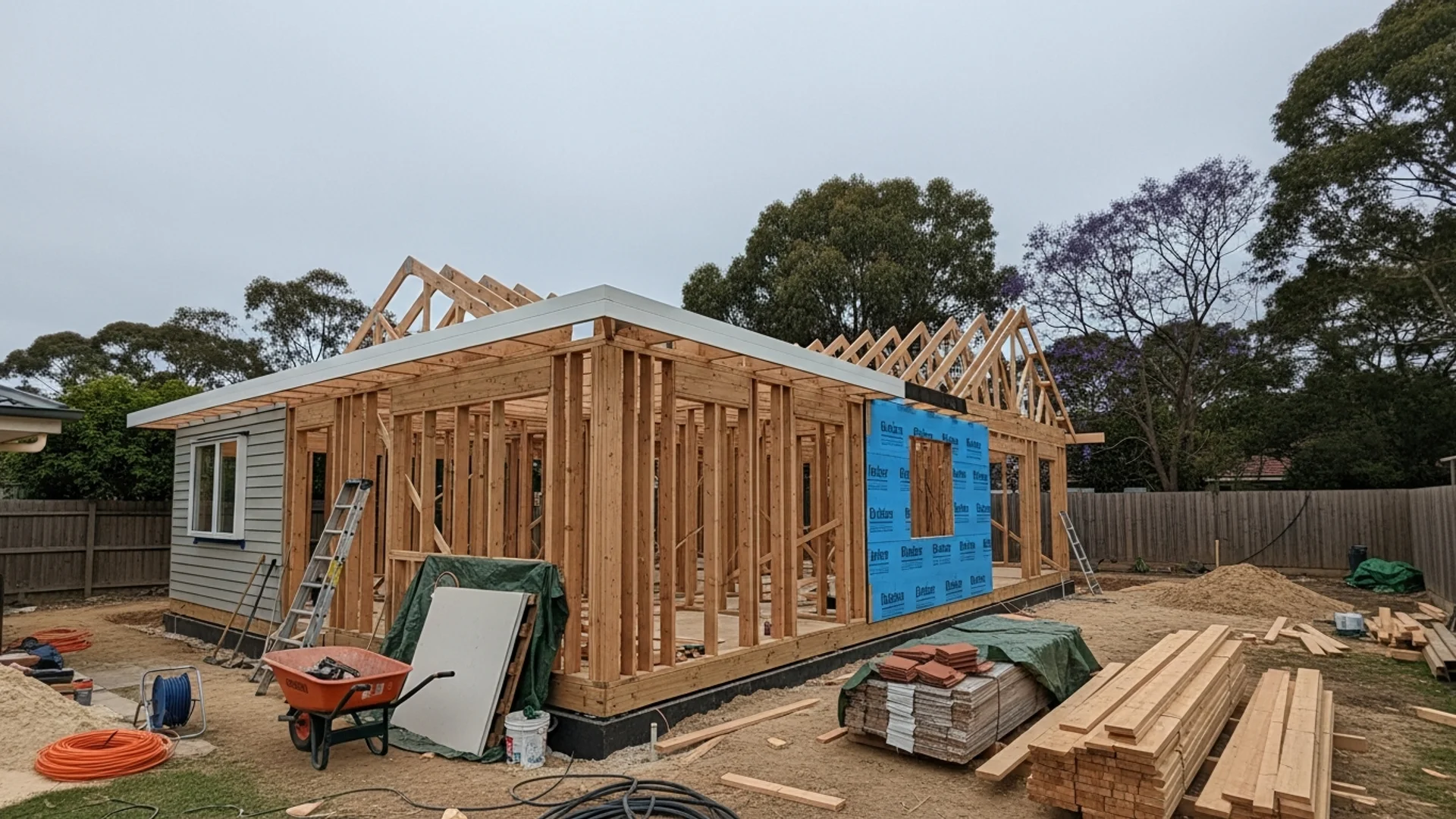
Granny Flat Cost Ranges by Build Type
These ranges represent typical all-in project costs including build, site works, approvals, and connections. Actual costs vary by site conditions, specification level, and location. All figures ex GST.
| Scenario | Cost range (AUD, ex GST) | Notes |
|---|---|---|
| Studio granny flat (under 40sqm) | $80,000–$150,000 | Self-contained open-plan studio. Lower end reflects basic kit-assembled builds; upper end reflects turnkey with quality finishes. |
| 1-bedroom granny flat (35–50sqm) | $100,000–$200,000 | Separate bedroom, living, kitchen, and bathroom. The most commonly built granny flat type in Australia. |
| 2-bedroom granny flat (50–60sqm) | $130,000–$280,000 | Two bedrooms, typically at or near the 60sqm NSW cap. Higher specification and rental yield potential. |
| Kit home (all-in project cost) | $90,000–$180,000 | Kit materials ($40K–$120K) plus slab, assembly labour, approvals, fit-out, and connections. Kit price alone is not project cost. |
| Modular / factory-built | $90,000–$200,000 | Factory-built modules transported to site. Includes transport, cranage, and on-site finishing. Site access constraints can add cost. |
| Custom site-built | $150,000–$400,000 | Architect-designed, built on-site. Complete design flexibility but the highest cost per square metre. |
Cost ranges are based on GrannyFlatGuide industry research, published builder pricing, and project data from Australian granny flat builders. Ranges represent typical all-in project costs including all four cost buckets. Individual quotes may fall outside these ranges depending on site conditions, specification level, and location.
Last checked: Invalid Date
What Drives Your Granny Flat Cost
Six factors have the biggest impact on your final granny flat building cost. Understanding these helps you make informed trade-offs during the planning stage.
Build type and construction method
Kit homes are the cheapest in materials but require you to coordinate assembly. Modular builds offer speed but add transport and cranage costs. Turnkey site-built projects cost more but include everything from design to handover. Custom builds are the most expensive per square metre.
Size and number of bedrooms
More floor area means more materials, labour, and finishing. A studio under 40sqm can cost 30–50% less than a 2-bedroom at 60sqm. In NSW, the 60sqm secondary dwelling cap limits how large you can build under the Housing SEPP.
Site conditions and access
A flat, clear site with good access keeps site costs low. Slopes, rock, poor drainage, narrow access, or overhead power lines can each add thousands. If your builder hasn't inspected your site in person, treat any site works quote as preliminary.
Specification and finish level
Standard finishes (laminate benchtops, vinyl plank floors, basic tapware) versus premium finishes (stone benchtops, timber floors, quality fixtures) can represent a $20,000–$40,000 difference on the same floor plan.
Approval pathway and state
A CDC in NSW is faster and cheaper than a DA. Victoria's energy and accessibility requirements add to build costs. Queensland costs vary by council. Each state has different fees, standards, and compliance costs that affect the total.
Distance from existing services
Water, sewer, electrical, and gas connections are priced largely by distance. A granny flat close to the main dwelling with short service runs costs significantly less to connect than one at the back of a deep block.
Granny flat builders in Australia
Browse profiles, compare service areas, and check reviews.

Garden Studios
★ 5.0 (63 reviews)
View profile →

Perway Ecopods
★ 5.0 (43 reviews)
Perth-based home renovation and construction company offering custom builds with transparent service.
View profile →

Out-Back Portable Buildings
★ 5.0 (25 reviews)
Custom-made, pre-fabricated transportable homes including granny flats, offices, and portable buildings.
View profile →

Adams Cabins
★ 5.0 (20 reviews)
Family-owned cabin builders specializing in log cabins, granny flats, and tiny homes in SE Queensland.
View profile →

ATN Constructions
★ 5.0 (18 reviews)
View profile →

Dare Constructions
★ 5.0 (16 reviews)
Steel frame construction specialist including granny flats, carports, sheds across Newcastle, Hunter Valley, and Sydney.
View profile →
GrannyFlatGuide is a comparison platform. Companies shown are filtered by relevance to this page. Listing does not imply endorsement. GrannyFlatGuide may receive a referral fee when you request quotes.
Our Cost Research Methodology
The cost ranges on this page are compiled from published builder pricing, direct builder enquiries, project cost data shared by Australian granny flat owners, and industry publications. We cross-reference multiple sources to establish realistic ranges rather than relying on any single builder's pricing. All cost figures are presented ex GST and represent typical all-in project costs — including the build, site works, council and approval fees, and utility connections. Individual projects may fall outside these ranges due to site-specific factors, regional market conditions, or specification choices. We do not accept payment from builders to influence cost data. Our research is independent.
Sources include published pricing from Australian granny flat builders, HIA housing data, council fee schedules (NSW, VIC, QLD), and project cost reports. Specific builder pricing is verified against multiple published sources before inclusion.
Last reviewed
Invalid Date
Next review due
Invalid Date
Check your property first
Enter your address to see zoning, overlays, and approval pathway — then connect with local builders when you’re ready.
What can you build on your property?
Enter your address and we'll check your zoning, overlays, and what's possible on your block.
We use your address to check council zoning and planning rules — not stored until you choose to continue.
The single most common question we hear is: how much does a granny flat actually cost? Not the "from $120K" you see on a builder's homepage — the real, all-in number that includes everything from the slab to the final council inspection.
The honest answer is that a typical turnkey granny flat in Australia costs between $120,000 and $250,000, depending on size, build type, site conditions, and your state's approval requirements. But that range is wide for a reason — your final cost depends on four distinct cost buckets, and the build itself is only one of them.
This guide breaks down granny flat building costs across every build type, explains where your money actually goes, and gives you the detail you need to budget realistically. All cost figures are ex GST and based on industry research current as of Q2 2026.
Understanding Granny Flat Building Costs
The Four Cost Buckets
Every granny flat project has four cost buckets. Builders typically quote on the first one — the build itself — but buckets two through four can add $25,000 to $80,000 or more to your total project cost. Understanding all four is the difference between a realistic budget and a nasty surprise.
Bucket 1: The Build (55–65% of total cost)
This is what most builders quote — the slab, frame, cladding, roofing, internal fit-out, kitchen, bathroom, flooring, and painting. For a standard turnkey 1-bedroom granny flat, expect $100,000 to $200,000 ex GST depending on specification level.
The build cost varies significantly by construction method. A kit granny flat delivered as pre-cut materials will cost less in materials but requires you to arrange assembly labour separately. A modular granny flat built in a factory and craned onto site often has a higher upfront price but a shorter on-site construction period. A custom site-built granny flat gives you the most design flexibility but typically sits at the top of the cost range.
Specification level is the biggest variable within any build type. A standard-finish 2-bedroom granny flat with laminate benchtops, vinyl plank flooring, and basic tapware might cost $130,000. Upgrade to stone benchtops, timber flooring, and premium fixtures, and you could add $20,000–$40,000 to the same floor plan.
Bucket 2: Site Works (15–25% of total cost)
Site works cover everything needed to prepare your block before the build starts — and this is where the biggest cost surprises happen. A flat, clear, accessible site with good drainage might add only $10,000–$15,000. A sloping site that needs excavation, retaining walls, and rock removal could add $30,000–$50,000 or more.
Common site work items include:
- Excavation and levelling — $3,000 to $15,000 depending on slope and soil type
- Retaining walls — $5,000 to $25,000+ for significant level changes
- Tree removal — $500 to $5,000 per tree (council approval may be required)
- Demolition — removing an existing shed or structure, $2,000 to $8,000
- Temporary fencing and erosion control — $1,500 to $3,000
Many turnkey builders include basic site preparation in their quoted price, but define "basic" differently. Always ask what's included and what triggers a variation. If your builder hasn't visited your site before quoting, treat the site works figure as an estimate.
Bucket 3: Council and Approvals (5–10% of total cost)
Approval costs depend on your state and which pathway you use. In NSW, a Complying Development Certificate (CDC) through a private certifier is the fastest and most common route — typically $5,000 to $8,000 including certifier fees, engineering, surveying, and soil testing. A Development Application (DA) through council costs more ($8,000 to $15,000) and takes longer (6–12+ weeks versus 10–20 business days for a CDC).
NSW also requires a BASIX certificate ($50 fee) demonstrating that your granny flat meets energy and water efficiency standards. Victoria requires a building permit for all builds. Queensland approval requirements vary significantly by council — some allow accepted development for secondary dwellings under certain sizes, while others require a full development application.
If you're exploring the approval process in detail, our granny flat rules guide covers state-by-state requirements including CDC vs DA pathways.
Bucket 4: Connections and Finishing (10–15% of total cost)
The final bucket covers utility connections, landscaping, and finishing works that turn a completed building into a liveable dwelling:
- Water and sewer connection — $3,000 to $8,000 depending on distance from mains
- Electrical connection — $2,000 to $6,000 for a separate meter and switchboard
- Gas connection — $1,500 to $4,000 (if applicable)
- Stormwater drainage — $1,500 to $5,000
- Landscaping and fencing — $2,000 to $10,000+
- Driveway or pathway — $1,000 to $5,000
Connection costs are heavily influenced by how far your granny flat sits from existing services. A build close to the main dwelling with short service runs will cost significantly less than one at the back of a deep block.
Cost by Build Type
As of Q2 2026, here are realistic all-in cost ranges (including all four buckets) by build type:
Studio granny flat (under 40sqm): $80,000 – $150,000. The most affordable option. Popular for Airbnb or single-occupant use. At the lower end, expect a basic kit-assembled studio; at the upper end, a turnkey build with quality finishes.
1-bedroom granny flat (35–50sqm): $100,000 – $200,000. The workhorse of the granny flat market. Most granny flat builders offer multiple 1-bedroom floor plans as their core product.
2-bedroom granny flat (50–60sqm): $130,000 – $280,000. The premium option in NSW (where 60sqm is the maximum for secondary dwellings). Higher rental yield potential — our 2-bedroom granny flat guide covers layout options and design considerations.
Kit home (materials only): $40,000 – $120,000. Remember, this is the kit price only. A realistic all-in project cost for a kit-based build is typically $90,000 – $180,000 once you add slab, assembly labour, approvals, fit-out, and connections.
Modular/factory-built: $90,000 – $200,000 all-in. Factory construction can reduce on-site build time to 1–2 weeks, but transport, cranage, and site access constraints can add significant cost.
Custom site-built: $150,000 – $400,000+. Architect-designed and built on-site to your specifications. The most expensive option but offers complete design flexibility.
State-by-State Cost Differences
Granny flat building costs vary by state due to different approval requirements, building standards, and market conditions.
NSW has the most established granny flat market thanks to the Housing SEPP, which created a streamlined CDC pathway. Competition among builders is strongest in Greater Sydney and the Central Coast, which helps keep prices competitive. The 60sqm floor area cap limits build size but keeps projects within a predictable cost range.
Victoria introduced small second dwelling provisions that removed the planning permit requirement for most builds under 60sqm on lots over 300sqm. However, Victoria's 7-star NatHERS energy rating requirement and Livable Housing Design Standard (Silver Level) compliance add to construction costs — expect a 5–10% premium over equivalent NSW builds.
Queensland varies significantly by council. Brisbane City Council, Gold Coast, and Sunshine Coast each have different secondary dwelling provisions. Some QLD councils allow builds up to 80–120sqm, which opens up larger (and more expensive) designs.
Western Australia uses R-Codes for ancillary dwellings. The Perth market has fewer specialist granny flat builders than Sydney, which can affect pricing.
How to Budget Realistically
Based on industry research, here is a practical budgeting approach:
- Get at least three quotes — compare like-for-like by ensuring each builder is quoting on the same inclusions
- Add 10–15% contingency — site surprises, design changes, and material price movements are common
- Ask about exclusions — turnkey doesn't always mean everything is included. Retaining walls, long service runs, tree removal, and utility authority fees are common exclusions
- Factor in holding costs — if you're building for rental income, include the months between starting and receiving your first rent payment
- Compare quotes from our granny flat builders directory to understand the market range in your area
Granny Flat Cost Ranges by Build Type
These ranges represent typical all-in project costs including build, site works, approvals, and connections. Actual costs vary by site conditions, specification level, and location. All figures ex GST.
| Scenario | Cost range (AUD, ex GST) | Notes |
|---|---|---|
| Studio granny flat (under 40sqm) | $80,000–$150,000 | Self-contained open-plan studio. Lower end reflects basic kit-assembled builds; upper end reflects turnkey with quality finishes. |
| 1-bedroom granny flat (35–50sqm) | $100,000–$200,000 | Separate bedroom, living, kitchen, and bathroom. The most commonly built granny flat type in Australia. |
| 2-bedroom granny flat (50–60sqm) | $130,000–$280,000 | Two bedrooms, typically at or near the 60sqm NSW cap. Higher specification and rental yield potential. |
| Kit home (all-in project cost) | $90,000–$180,000 | Kit materials ($40K–$120K) plus slab, assembly labour, approvals, fit-out, and connections. Kit price alone is not project cost. |
| Modular / factory-built | $90,000–$200,000 | Factory-built modules transported to site. Includes transport, cranage, and on-site finishing. Site access constraints can add cost. |
| Custom site-built | $150,000–$400,000 | Architect-designed, built on-site. Complete design flexibility but the highest cost per square metre. |
Cost ranges are based on GrannyFlatGuide industry research, published builder pricing, and project data from Australian granny flat builders. Ranges represent typical all-in project costs including all four cost buckets. Individual quotes may fall outside these ranges depending on site conditions, specification level, and location.
Last checked: Invalid Date
What Drives Your Granny Flat Cost
Six factors have the biggest impact on your final granny flat building cost. Understanding these helps you make informed trade-offs during the planning stage.
Build type and construction method
Kit homes are the cheapest in materials but require you to coordinate assembly. Modular builds offer speed but add transport and cranage costs. Turnkey site-built projects cost more but include everything from design to handover. Custom builds are the most expensive per square metre.
Size and number of bedrooms
More floor area means more materials, labour, and finishing. A studio under 40sqm can cost 30–50% less than a 2-bedroom at 60sqm. In NSW, the 60sqm secondary dwelling cap limits how large you can build under the Housing SEPP.
Site conditions and access
A flat, clear site with good access keeps site costs low. Slopes, rock, poor drainage, narrow access, or overhead power lines can each add thousands. If your builder hasn't inspected your site in person, treat any site works quote as preliminary.
Specification and finish level
Standard finishes (laminate benchtops, vinyl plank floors, basic tapware) versus premium finishes (stone benchtops, timber floors, quality fixtures) can represent a $20,000–$40,000 difference on the same floor plan.
Approval pathway and state
A CDC in NSW is faster and cheaper than a DA. Victoria's energy and accessibility requirements add to build costs. Queensland costs vary by council. Each state has different fees, standards, and compliance costs that affect the total.
Distance from existing services
Water, sewer, electrical, and gas connections are priced largely by distance. A granny flat close to the main dwelling with short service runs costs significantly less to connect than one at the back of a deep block.
Granny flat builders in Australia
Browse profiles, compare service areas, and check reviews.
Garden Studios
★ 5.0 (63 reviews)
View profile →
Perway Ecopods
★ 5.0 (43 reviews)
Perth-based home renovation and construction company offering custom builds with transparent service.
View profile →
Out-Back Portable Buildings
★ 5.0 (25 reviews)
Custom-made, pre-fabricated transportable homes including granny flats, offices, and portable buildings.
View profile →
Adams Cabins
★ 5.0 (20 reviews)
Family-owned cabin builders specializing in log cabins, granny flats, and tiny homes in SE Queensland.
View profile →
ATN Constructions
★ 5.0 (18 reviews)
View profile →
Dare Constructions
★ 5.0 (16 reviews)
Steel frame construction specialist including granny flats, carports, sheds across Newcastle, Hunter Valley, and Sydney.
View profile →
GrannyFlatGuide is a comparison platform. Companies shown are filtered by relevance to this page. Listing does not imply endorsement. GrannyFlatGuide may receive a referral fee when you request quotes.
Our Cost Research Methodology
The cost ranges on this page are compiled from published builder pricing, direct builder enquiries, project cost data shared by Australian granny flat owners, and industry publications. We cross-reference multiple sources to establish realistic ranges rather than relying on any single builder's pricing. All cost figures are presented ex GST and represent typical all-in project costs — including the build, site works, council and approval fees, and utility connections. Individual projects may fall outside these ranges due to site-specific factors, regional market conditions, or specification choices. We do not accept payment from builders to influence cost data. Our research is independent.
Sources include published pricing from Australian granny flat builders, HIA housing data, council fee schedules (NSW, VIC, QLD), and project cost reports. Specific builder pricing is verified against multiple published sources before inclusion.
Last reviewed
Invalid Date
Next review due
Invalid Date
Check your property first
Enter your address to see zoning, overlays, and approval pathway — then connect with local builders when you’re ready.
What can you build on your property?
Enter your address and we'll check your zoning, overlays, and what's possible on your block.
We use your address to check council zoning and planning rules — not stored until you choose to continue.
Frequently asked questions
A typical turnkey granny flat costs between $120,000 and $250,000 all-in, depending on size, build type, site conditions, and your state. A studio under 40sqm starts from around $80,000, while a 2-bedroom at 60sqm can reach $280,000 or more with premium finishes. These figures are ex GST and include the build, site works, approvals, and connections.
A turnkey price typically covers design, council approvals, slab, frame, cladding, roofing, internal fit-out (kitchen, bathroom, flooring, painting), and basic site preparation. However, 'turnkey' doesn't always mean everything — common exclusions include retaining walls, tree removal, long service runs, utility authority fees, and landscaping. Always ask your builder for a detailed list of inclusions and exclusions.
Site works typically add $10,000 to $50,000 or more to your project cost, depending on your block. A flat, clear, well-drained site with good access might only need $10,000–$15,000 in preparation. A sloping site requiring excavation, retaining walls, or rock removal can add $30,000–$50,000+. Always get a site-specific quote rather than relying on standard allowances.
Kit materials are cheaper ($40,000–$120,000), but the total project cost for a kit-based build is typically $90,000–$180,000 once you add slab, assembly labour, approvals, fit-out, and connections. The savings compared to turnkey are real but smaller than the kit price alone suggests — usually 10–25% less for a comparable finished product.
In NSW, a CDC through a private certifier costs $5,000–$8,000 including certifier fees, engineering, surveying, soil testing, and the $50 BASIX certificate. A DA through council costs $8,000–$15,000 and takes significantly longer. Costs vary by state — Victoria requires a building permit, and Queensland requirements differ by council.
A 1-bedroom granny flat typically costs $100,000–$200,000 all-in (ex GST) including all four cost buckets — the build, site works, approvals, and connections. This is the most commonly built granny flat type in Australia, with separate bedroom, living area, kitchen, and bathroom in 35–50sqm of floor area.
A 2-bedroom granny flat costs $130,000–$280,000 all-in (ex GST). In NSW, a 2-bedroom design typically uses most or all of the 60sqm floor area cap. The higher cost reflects more materials, a larger slab, and additional labour. Two-bedroom builds offer stronger rental yield potential, making them popular with investors.
Yes. NSW has the most competitive market and streamlined approvals (CDC pathway). Victoria's 7-star energy rating and Livable Housing Design Standard add 5–10% to build costs. Queensland varies by council, with some allowing larger builds (80–120sqm). Western Australia uses R-Codes with fewer specialist builders, which can affect pricing.
A typical site-built granny flat takes 12–16 weeks from slab to handover, plus 2–8 weeks for approvals beforehand. Modular and transportable builds can reduce on-site time to 1–4 weeks, though factory lead times and transport logistics add to the overall timeline. Council DAs can extend the approval phase to 3–6 months.
Yes — industry practice is to add 10–15% contingency on top of your quoted price. Common cost overruns include unexpected site conditions (rock, poor soil), design changes during construction, material price increases, and utility connection complications. A contingency buffer prevents these from derailing your project.
Related guides
Guide
Granny Flat Rules Victoria 2026 — Planning & Building Guide
Victoria's granny flat rules explained — planning permits, 60sqm cap, building requirements, DPU changes, and how the 2023-2026 reforms affect your build.
Guide
Granny Flat Rules NSW — CDC, Setbacks & Approvals (2026)
NSW granny flat rules explained — lot size minimums, CDC vs DA pathways, setback distances and BASIX requirements under SEPP (Housing) 2021.
Cost guide
2 Bedroom Granny Flat Cost — Pricing by Build Type (2026)
A 2-bedroom granny flat costs $114,000–$237,000 GST-inclusive in Australia. See pricing by build type (kit, prefab, custom), state, and finish level.
Cost guide
Granny Flat Prices in Australia — Real Builder Pricing Compared (2026)
Compare real granny flat prices across budget prefab, mid-range custom, and premium turnkey tiers. See what the 'from' price includes and what you'll actually pay in 2026.
Ready to compare granny flat quotes?
Get free, no-obligation quotes from vetted granny flat builders in your area. Compare prices, inclusions, and timelines side by side.
Join 1,000+ Australians who've used GrannyFlatGuide to research their granny flat project
Get free quotes