Granny Flat Designs: Styles, Floor Plans and Layout Ideas
From modern minimalist to coastal Hamptons — discover which granny flat design suits your site, budget and lifestyle.
Design styles at a glance
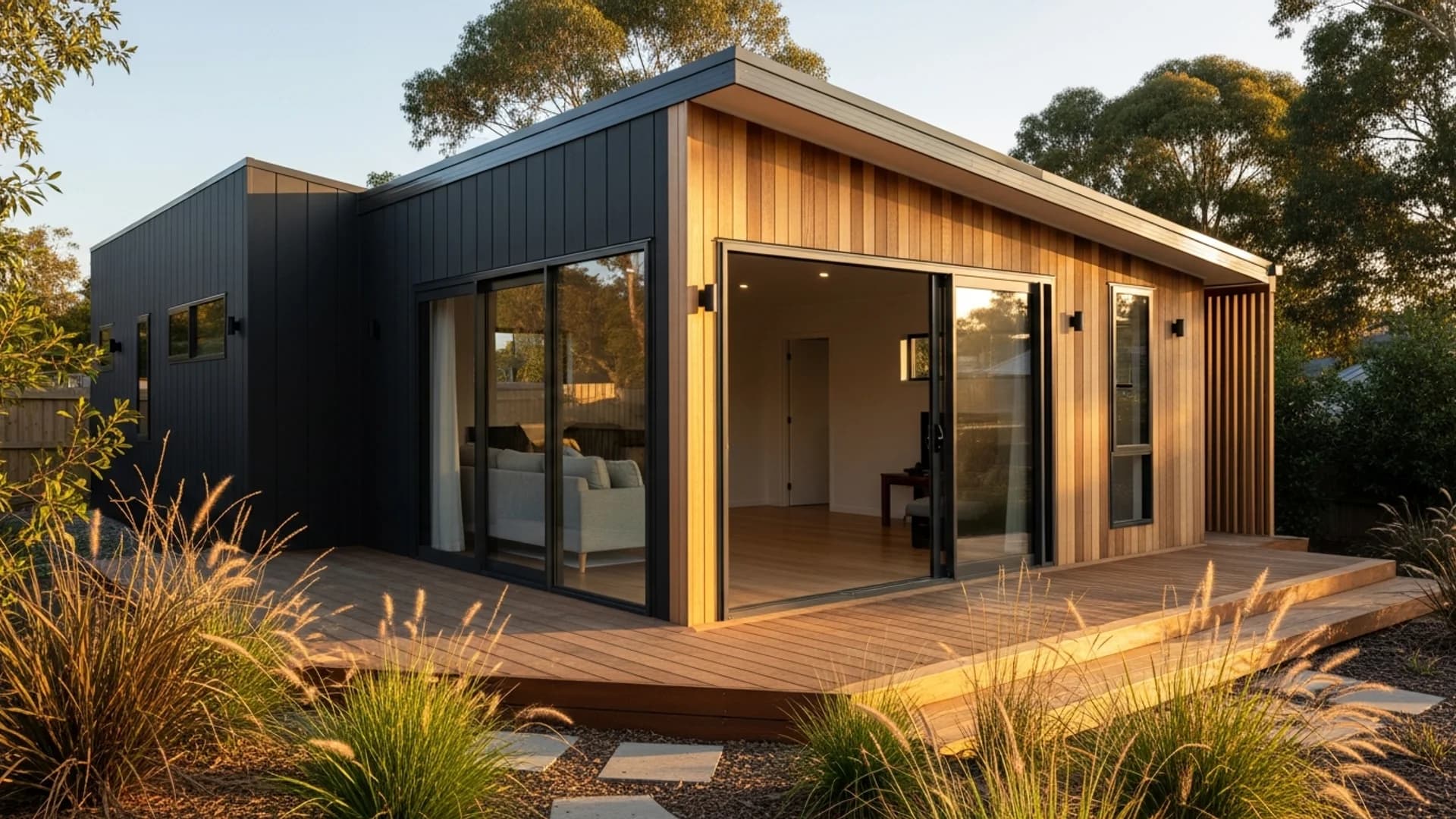
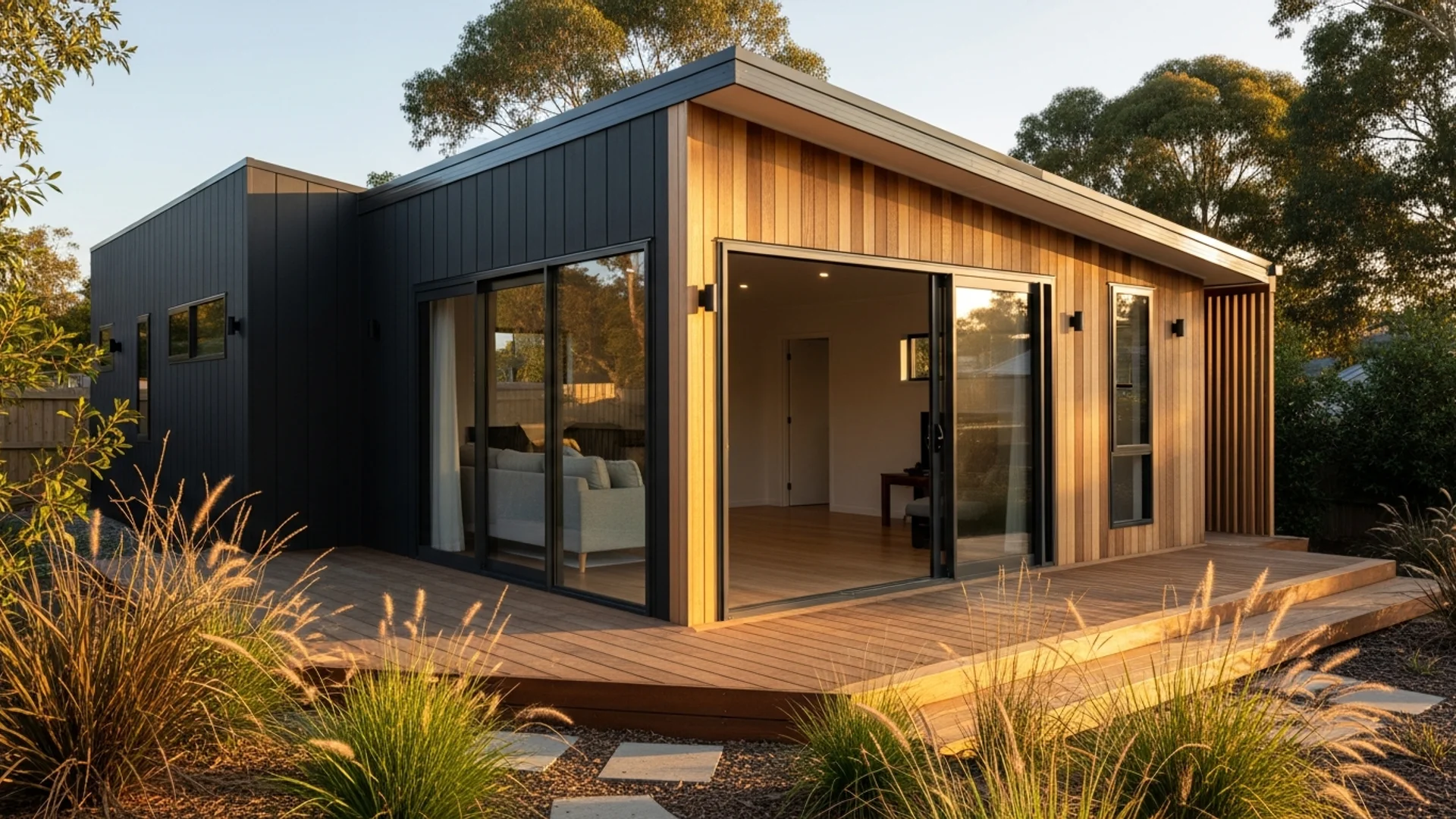
Modern minimalist
Clean lines, flat or skillion roofing, mixed cladding (fibre cement + timber battens), and open-plan living. The most popular style for rental-focused builds — tenants prefer contemporary finishes and low-maintenance exteriors.
Traditional / cottage
Pitched roof, weatherboard or brick veneer cladding, and a covered front porch. Blends seamlessly with older Australian homes and suits family accommodation where matching the main dwelling matters.
Coastal / Hamptons
Light-coloured weatherboard, wide covered deck, louvre windows for cross-ventilation, and an emphasis on indoor-outdoor flow. Popular in coastal and semi-rural areas across NSW and QLD.
Bush retreat / studio
Natural timber cladding, compact open-plan layout, and strong connection to the garden. Well-suited to home offices, creative studios, and properties with established native landscaping.
Choosing the right granny flat design is one of the most important decisions you will make during your build. The design affects everything — how much natural light enters each room, how well the space ventilates in summer, whether your granny flat feels cramped or surprisingly spacious, and ultimately how much the entire project costs.
Australian granny flat designs have evolved well beyond the basic rectangular box. Today's designs range from sleek modern builds with mixed cladding and floor-to-ceiling glass, through to traditional weatherboard cottages that blend with established streetscapes. The best design for your project depends on three things: what the granny flat will be used for, what your site allows, and how much you want to spend.
This guide covers the most popular granny flat design styles in Australia, explains the floor plan decisions that matter most, and helps you match a design direction to your specific situation — whether you are building for family, rental income, or downsizing.
Granny flat design guide

How to choose the right granny flat design
The right granny flat design starts with one question: what is this building for? A granny flat designed for ageing parents has fundamentally different requirements from one built to maximise rental yield. Your primary use case drives the layout, the features, and the design style.
If you are building for family accommodation, prioritise separate bedrooms, a full kitchen with adequate bench space, a bathroom with universal design features (step-free shower, reinforced walls for future grabrails), and a covered entry that provides weather protection. A traditional or cottage-style design works well here — it respects the character of the main dwelling and feels like a genuine home rather than a rental unit.
For rental income, the modern minimalist approach dominates. Tenants in the $350–$550 per week bracket expect contemporary finishes: stone-look benchtops, modern tapware, tiled splashbacks, and good natural light. Open-plan living with a clearly defined bedroom zone delivers the best combination of liveability and floor area efficiency. A separate entry and visual privacy from the main house are essential for tenant appeal — and they help you achieve higher rents.
If you are downsizing into the granny flat yourself, accessibility and comfort become the priority. The Livable Housing Design Standard (Silver Level) is a useful benchmark even where it is not mandatory — step-free entry, 820mm minimum doorways, a hobless shower, and reinforced bathroom walls for future grabrails. A coastal or Hamptons-style design with a wide wrap-around deck extends usable living space without counting toward the 60sqm internal floor area cap in NSW.
For a home office or studio, compact open-plan layouts between 25 and 40 sqm work best. The bush retreat style — natural timber battens, large windows facing the garden, and a covered deck for breakout space — creates a working environment that feels separate from the main house without the cost of a full residential fitout.
Floor plan fundamentals that matter
Good granny flat design is not about choosing the most expensive option. It is about making smart decisions with the available floor area — and in most of Australia, that floor area is limited.
In NSW, the Housing SEPP caps secondary dwelling internal floor area at 60 sqm. This is a hard limit for CDC approval. Every square metre counts, and design decisions that waste space — long hallways, oversized bathrooms, poorly placed doors — are expensive mistakes in a 60 sqm footprint.
In Queensland, floor area limits vary by council and lot size. Some councils allow up to 80 sqm on lots under 1,000 sqm, and 100 sqm on larger lots. This extra space makes three-bedroom designs feasible in QLD where they would be impractical under NSW rules.
In Victoria, small second dwellings under 60 sqm on lots over 300 sqm in residential zones generally no longer require a planning permit — though building permits are always required.
Orientation and natural light
The single most impactful design decision is orientation. Position living areas to face north wherever site constraints allow. North-facing windows capture winter sun and can be shaded from summer sun with appropriately sized eaves or external louvres. This is not just about comfort — it directly affects your BASIX score in NSW and NatHERS rating in other states, which in turn affects approval.
East-facing bedrooms catch morning light, which most occupants prefer. West-facing glass should be minimised or fitted with external shading — unshaded western glazing is the single largest contributor to summer heat gain in compact dwellings.
Cross-ventilation
Every habitable room should have openable windows on at least two walls. In a compact granny flat, this often means carefully positioning the bathroom and kitchen to avoid blocking airflow paths. Louvre windows and highlight windows are effective in tight spaces where full-height windows are not practical.
Good cross-ventilation reduces reliance on mechanical cooling, which matters for both running costs and energy compliance. In subtropical QLD, effective passive ventilation can eliminate the need for air conditioning entirely in a well-oriented granny flat.
Indoor-outdoor connection
A covered deck or verandah is one of the most cost-effective design features in any granny flat. Deck area does not count toward the internal floor area cap in NSW (provided it is unenclosed), so a 60 sqm granny flat with a 12 sqm deck delivers 72 sqm of usable space.
Full-width sliding doors between the living area and deck blur the boundary and make a compact interior feel significantly larger. This is a standard feature in both modern and coastal design styles, and builders report it is one of the most requested upgrades.
Popular granny flat floor plan layouts
Studio layout (25–40 sqm)
An open-plan living, sleeping, and kitchen area with a separate bathroom. Studios work well for singles, couples, or short-term rental. The key design challenge is creating a sense of separation between sleeping and living zones without wasting space on walls. A partial-height joinery unit or a change in ceiling height can define zones effectively.
Typical cost: $80,000–$150,000 turnkey (as of Q2 2026). See our granny flat cost guide for a detailed breakdown.
One-bedroom layout (35–50 sqm)
A separate bedroom, combined living and kitchen area, bathroom, and often a small laundry space. This is the most common granny flat layout in Australia because it balances liveability with the 60 sqm constraint. The best 1-bedroom granny flat designs place the bedroom at one end with the bathroom acting as a sound buffer between the bedroom and living areas.
Two-bedroom layout (50–60 sqm)
Two bedrooms, open-plan living and kitchen, bathroom, and a European-style laundry. At 60 sqm, every design decision has to earn its space. The most efficient layouts place both bedrooms on one side with a shared bathroom between them, leaving the remaining area for a generous living and kitchen zone. A 2-bedroom granny flat typically commands $50–$100 per week more in rent than a comparable 1-bedroom.
Matching design to your site
The best granny flat design on paper means nothing if it does not work on your actual block. Before committing to a floor plan, consider these site-specific factors:
Setback requirements determine where the granny flat can physically sit on the lot. In NSW, the Housing SEPP requires a 900mm side setback and 3m rear setback for CDC approval. Your design may need to be narrower than standard to fit within these boundaries.
Access for construction affects whether modular or transportable designs are feasible. If your backyard is only accessible through a 3m side gate, a factory-built module that requires a crane and clear overhead space may not be practical — regardless of how appealing the design is.
Existing trees and services constrain the building envelope. Significant trees with tree preservation orders may force the granny flat footprint to shift, and the location of sewer, water, and power connections affects both design and site costs.
Privacy is often the overlooked design factor. Position bedroom and bathroom windows away from the main dwelling's living areas and neighbouring properties. Highlight windows (above eye level) and frosted glass maintain natural light while preserving privacy on both sides.
The best starting point is to get your block assessed by two or three granny flat builders who offer free site inspections. They will identify constraints you may not have considered and recommend designs that actually work on your specific lot.
What design features cost extra
Not every design upgrade is worth the investment. Here is a practical guide to which features add genuine value and which are purely cosmetic:
Worth the spend: north-facing orientation (free at design stage), covered deck ($8,000–$15,000), separate entry path ($2,000–$5,000), good cross-ventilation (design-stage decision), and step-free entry ($500–$2,000 if designed in from the start).
Diminishing returns: premium tapware and fixtures (tenants do not pay more for them), complex rooflines (add cost without proportional value), excessive built-in joinery (limits furniture flexibility), and feature lighting (better invested in natural light).
Site-dependent value: air conditioning ($3,000–$6,000 — essential in western Sydney and inland QLD, optional in coastal areas with good ventilation), insulation upgrades ($1,500–$3,000 — strong ROI in all climates), and solar panels ($3,000–$6,000 — excellent ROI for owner-occupied, less relevant for rental).
Next steps: from design to reality
A design is only useful if it can be built on your site, within your budget, and with the right approvals. The fastest way to move forward is to compare quotes from builders who specialise in the design style you prefer. Most reputable granny flat builders offer free initial consultations that include a site assessment and preliminary design — use these to test your ideas against reality before committing to detailed plans.
Granny flat builders in Australia
Browse profiles, compare service areas, and check reviews.

Garden Studios
★ 5.0 (63 reviews)
View profile →

Perway Ecopods
★ 5.0 (43 reviews)
Perth-based home renovation and construction company offering custom builds with transparent service.
View profile →

Out-Back Portable Buildings
★ 5.0 (25 reviews)
Custom-made, pre-fabricated transportable homes including granny flats, offices, and portable buildings.
View profile →

Adams Cabins
★ 5.0 (20 reviews)
Family-owned cabin builders specializing in log cabins, granny flats, and tiny homes in SE Queensland.
View profile →

ATN Constructions
★ 5.0 (18 reviews)
View profile →

Dare Constructions
★ 5.0 (16 reviews)
Steel frame construction specialist including granny flats, carports, sheds across Newcastle, Hunter Valley, and Sydney.
View profile →
GrannyFlatGuide is a comparison platform. Companies shown are filtered by relevance to this page. Listing does not imply endorsement. GrannyFlatGuide may receive a referral fee when you request quotes.
Put this into action
Check your property’s zoning and approval pathway, then connect with verified builders when you’re ready.
What can you build on your property?
Enter your address and we'll check your zoning, overlays, and what's possible on your block.
We use your address to check council zoning and planning rules — not stored until you choose to continue.
Choosing the right granny flat design is one of the most important decisions you will make during your build. The design affects everything — how much natural light enters each room, how well the space ventilates in summer, whether your granny flat feels cramped or surprisingly spacious, and ultimately how much the entire project costs.
Australian granny flat designs have evolved well beyond the basic rectangular box. Today's designs range from sleek modern builds with mixed cladding and floor-to-ceiling glass, through to traditional weatherboard cottages that blend with established streetscapes. The best design for your project depends on three things: what the granny flat will be used for, what your site allows, and how much you want to spend.
This guide covers the most popular granny flat design styles in Australia, explains the floor plan decisions that matter most, and helps you match a design direction to your specific situation — whether you are building for family, rental income, or downsizing.
Granny flat design guide
How to choose the right granny flat design
The right granny flat design starts with one question: what is this building for? A granny flat designed for ageing parents has fundamentally different requirements from one built to maximise rental yield. Your primary use case drives the layout, the features, and the design style.
If you are building for family accommodation, prioritise separate bedrooms, a full kitchen with adequate bench space, a bathroom with universal design features (step-free shower, reinforced walls for future grabrails), and a covered entry that provides weather protection. A traditional or cottage-style design works well here — it respects the character of the main dwelling and feels like a genuine home rather than a rental unit.
For rental income, the modern minimalist approach dominates. Tenants in the $350–$550 per week bracket expect contemporary finishes: stone-look benchtops, modern tapware, tiled splashbacks, and good natural light. Open-plan living with a clearly defined bedroom zone delivers the best combination of liveability and floor area efficiency. A separate entry and visual privacy from the main house are essential for tenant appeal — and they help you achieve higher rents.
If you are downsizing into the granny flat yourself, accessibility and comfort become the priority. The Livable Housing Design Standard (Silver Level) is a useful benchmark even where it is not mandatory — step-free entry, 820mm minimum doorways, a hobless shower, and reinforced bathroom walls for future grabrails. A coastal or Hamptons-style design with a wide wrap-around deck extends usable living space without counting toward the 60sqm internal floor area cap in NSW.
For a home office or studio, compact open-plan layouts between 25 and 40 sqm work best. The bush retreat style — natural timber battens, large windows facing the garden, and a covered deck for breakout space — creates a working environment that feels separate from the main house without the cost of a full residential fitout.
Floor plan fundamentals that matter
Good granny flat design is not about choosing the most expensive option. It is about making smart decisions with the available floor area — and in most of Australia, that floor area is limited.
In NSW, the Housing SEPP caps secondary dwelling internal floor area at 60 sqm. This is a hard limit for CDC approval. Every square metre counts, and design decisions that waste space — long hallways, oversized bathrooms, poorly placed doors — are expensive mistakes in a 60 sqm footprint.
In Queensland, floor area limits vary by council and lot size. Some councils allow up to 80 sqm on lots under 1,000 sqm, and 100 sqm on larger lots. This extra space makes three-bedroom designs feasible in QLD where they would be impractical under NSW rules.
In Victoria, small second dwellings under 60 sqm on lots over 300 sqm in residential zones generally no longer require a planning permit — though building permits are always required.
Orientation and natural light
The single most impactful design decision is orientation. Position living areas to face north wherever site constraints allow. North-facing windows capture winter sun and can be shaded from summer sun with appropriately sized eaves or external louvres. This is not just about comfort — it directly affects your BASIX score in NSW and NatHERS rating in other states, which in turn affects approval.
East-facing bedrooms catch morning light, which most occupants prefer. West-facing glass should be minimised or fitted with external shading — unshaded western glazing is the single largest contributor to summer heat gain in compact dwellings.
Cross-ventilation
Every habitable room should have openable windows on at least two walls. In a compact granny flat, this often means carefully positioning the bathroom and kitchen to avoid blocking airflow paths. Louvre windows and highlight windows are effective in tight spaces where full-height windows are not practical.
Good cross-ventilation reduces reliance on mechanical cooling, which matters for both running costs and energy compliance. In subtropical QLD, effective passive ventilation can eliminate the need for air conditioning entirely in a well-oriented granny flat.
Indoor-outdoor connection
A covered deck or verandah is one of the most cost-effective design features in any granny flat. Deck area does not count toward the internal floor area cap in NSW (provided it is unenclosed), so a 60 sqm granny flat with a 12 sqm deck delivers 72 sqm of usable space.
Full-width sliding doors between the living area and deck blur the boundary and make a compact interior feel significantly larger. This is a standard feature in both modern and coastal design styles, and builders report it is one of the most requested upgrades.
Popular granny flat floor plan layouts
Studio layout (25–40 sqm)
An open-plan living, sleeping, and kitchen area with a separate bathroom. Studios work well for singles, couples, or short-term rental. The key design challenge is creating a sense of separation between sleeping and living zones without wasting space on walls. A partial-height joinery unit or a change in ceiling height can define zones effectively.
Typical cost: $80,000–$150,000 turnkey (as of Q2 2026). See our granny flat cost guide for a detailed breakdown.
One-bedroom layout (35–50 sqm)
A separate bedroom, combined living and kitchen area, bathroom, and often a small laundry space. This is the most common granny flat layout in Australia because it balances liveability with the 60 sqm constraint. The best 1-bedroom granny flat designs place the bedroom at one end with the bathroom acting as a sound buffer between the bedroom and living areas.
Two-bedroom layout (50–60 sqm)
Two bedrooms, open-plan living and kitchen, bathroom, and a European-style laundry. At 60 sqm, every design decision has to earn its space. The most efficient layouts place both bedrooms on one side with a shared bathroom between them, leaving the remaining area for a generous living and kitchen zone. A 2-bedroom granny flat typically commands $50–$100 per week more in rent than a comparable 1-bedroom.
Matching design to your site
The best granny flat design on paper means nothing if it does not work on your actual block. Before committing to a floor plan, consider these site-specific factors:
Setback requirements determine where the granny flat can physically sit on the lot. In NSW, the Housing SEPP requires a 900mm side setback and 3m rear setback for CDC approval. Your design may need to be narrower than standard to fit within these boundaries.
Access for construction affects whether modular or transportable designs are feasible. If your backyard is only accessible through a 3m side gate, a factory-built module that requires a crane and clear overhead space may not be practical — regardless of how appealing the design is.
Existing trees and services constrain the building envelope. Significant trees with tree preservation orders may force the granny flat footprint to shift, and the location of sewer, water, and power connections affects both design and site costs.
Privacy is often the overlooked design factor. Position bedroom and bathroom windows away from the main dwelling's living areas and neighbouring properties. Highlight windows (above eye level) and frosted glass maintain natural light while preserving privacy on both sides.
The best starting point is to get your block assessed by two or three granny flat builders who offer free site inspections. They will identify constraints you may not have considered and recommend designs that actually work on your specific lot.
What design features cost extra
Not every design upgrade is worth the investment. Here is a practical guide to which features add genuine value and which are purely cosmetic:
Worth the spend: north-facing orientation (free at design stage), covered deck ($8,000–$15,000), separate entry path ($2,000–$5,000), good cross-ventilation (design-stage decision), and step-free entry ($500–$2,000 if designed in from the start).
Diminishing returns: premium tapware and fixtures (tenants do not pay more for them), complex rooflines (add cost without proportional value), excessive built-in joinery (limits furniture flexibility), and feature lighting (better invested in natural light).
Site-dependent value: air conditioning ($3,000–$6,000 — essential in western Sydney and inland QLD, optional in coastal areas with good ventilation), insulation upgrades ($1,500–$3,000 — strong ROI in all climates), and solar panels ($3,000–$6,000 — excellent ROI for owner-occupied, less relevant for rental).
Next steps: from design to reality
A design is only useful if it can be built on your site, within your budget, and with the right approvals. The fastest way to move forward is to compare quotes from builders who specialise in the design style you prefer. Most reputable granny flat builders offer free initial consultations that include a site assessment and preliminary design — use these to test your ideas against reality before committing to detailed plans.
Granny flat builders in Australia
Browse profiles, compare service areas, and check reviews.
Garden Studios
★ 5.0 (63 reviews)
View profile →
Perway Ecopods
★ 5.0 (43 reviews)
Perth-based home renovation and construction company offering custom builds with transparent service.
View profile →
Out-Back Portable Buildings
★ 5.0 (25 reviews)
Custom-made, pre-fabricated transportable homes including granny flats, offices, and portable buildings.
View profile →
Adams Cabins
★ 5.0 (20 reviews)
Family-owned cabin builders specializing in log cabins, granny flats, and tiny homes in SE Queensland.
View profile →
ATN Constructions
★ 5.0 (18 reviews)
View profile →
Dare Constructions
★ 5.0 (16 reviews)
Steel frame construction specialist including granny flats, carports, sheds across Newcastle, Hunter Valley, and Sydney.
View profile →
GrannyFlatGuide is a comparison platform. Companies shown are filtered by relevance to this page. Listing does not imply endorsement. GrannyFlatGuide may receive a referral fee when you request quotes.
Put this into action
Check your property’s zoning and approval pathway, then connect with verified builders when you’re ready.
What can you build on your property?
Enter your address and we'll check your zoning, overlays, and what's possible on your block.
We use your address to check council zoning and planning rules — not stored until you choose to continue.
Frequently asked questions
The four most popular styles are modern minimalist (flat roof, mixed cladding, open plan), traditional cottage (pitched roof, weatherboard), coastal/Hamptons (light cladding, wide deck, louvres), and bush retreat (natural timber, garden-facing). Modern minimalist is the most common choice for rental-focused builds, while traditional styles suit family accommodation.
In NSW, the Housing SEPP caps secondary dwelling internal floor area at 60 sqm for CDC (Complying Development Certificate) approval. Decks and covered outdoor areas do not count toward this limit provided they are unenclosed, so a 60 sqm granny flat with a 12 sqm deck delivers 72 sqm of usable space.
Most turnkey builders include design as part of their package at no additional cost. If you engage an independent architect or building designer separately, expect to pay $3,000–$10,000 for a full set of construction drawings. Design and approval packages from specialist granny flat companies typically range from $5,000–$15,000 including CDC or DA lodgement.
Open-plan layouts maximise the sense of space and work best in studios and smaller 1-bedroom designs. Separate rooms become more practical in 2-bedroom layouts where acoustic privacy between bedrooms matters. For rental properties, open-plan living with separate bedrooms is the most tenant-friendly layout.
Position living areas to face north wherever possible. North-facing windows capture winter sun while being easy to shade in summer with eaves or louvres. East-facing bedrooms catch morning light. Minimise west-facing glass — unshaded western glazing is the largest contributor to summer heat gain in compact dwellings.
You can create your own concept layout, but construction drawings must be prepared by a qualified building designer or architect to meet NCC (National Construction Code) requirements and obtain approval. Many builders offer design-and-build packages where they handle the drafting based on your preferences and site constraints.
A granny flat (secondary dwelling) is a smaller dwelling subordinate to the main house, capped at 60 sqm in NSW. It cannot be subdivided onto a separate title. A dual occupancy is two dwellings of similar scale on the same lot, with no 60 sqm cap, but it generally requires a DA and costs significantly more ($300K–$600K+). Dual occupancy may allow subdivision.
No. Unenclosed covered decks, verandahs, and pergolas do not count toward the 60 sqm internal floor area cap in NSW. This makes a deck one of the most cost-effective design additions — it extends usable living space without affecting your compliance with the Housing SEPP size limit.
Modern minimalist designs with open-plan living, contemporary finishes, a separate entry, and visual privacy from the main dwelling achieve the highest rental returns. Two-bedroom layouts command $50–$100 per week more than 1-bedroom designs. Low-maintenance exteriors (fibre cement, Colorbond) reduce ongoing costs.
Use north-facing full-height windows for natural light, install full-width sliding doors to a deck for indoor-outdoor flow, choose light-coloured interior finishes, minimise hallway space, and use partial-height joinery or ceiling height changes to define zones without walls. A 60 sqm granny flat with good design can feel more spacious than a poorly designed 80 sqm apartment.
At minimum, consider step-free entry, 820mm doorways (especially to bathroom and bedroom), a hobless shower recess, reinforced bathroom walls for future grabrail installation, and lever-style door handles and tapware. These features align with the Livable Housing Design Standard (Silver Level) and add minimal cost when designed in from the start — typically $500–$2,000.
In NSW, the 60 sqm cap makes a genuine 3-bedroom layout impractical — bedrooms would be too small to be liveable. In Queensland, some councils allow secondary dwellings up to 80–120 sqm depending on lot size, which makes 3-bedroom designs feasible. Check your specific council's planning scheme for floor area limits.
Related guides
Guide
Granny Flat Rules Victoria 2026 — Planning & Building Guide
Victoria's granny flat rules explained — planning permits, 60sqm cap, building requirements, DPU changes, and how the 2023-2026 reforms affect your build.
Guide
Granny Flat Rules NSW — CDC, Setbacks & Approvals (2026)
NSW granny flat rules explained — lot size minimums, CDC vs DA pathways, setback distances and BASIX requirements under SEPP (Housing) 2021.
Cost guide
2 Bedroom Granny Flat Cost — Pricing by Build Type (2026)
A 2-bedroom granny flat costs $114,000–$237,000 GST-inclusive in Australia. See pricing by build type (kit, prefab, custom), state, and finish level.
Cost guide
Granny Flat Prices in Australia — Real Builder Pricing Compared (2026)
Compare real granny flat prices across budget prefab, mid-range custom, and premium turnkey tiers. See what the 'from' price includes and what you'll actually pay in 2026.
Ready to compare granny flat design quotes?
Get free, no-obligation quotes from vetted Australian granny flat builders. Compare designs, pricing and timelines side by side.
Join 1,000+ Australians who've used GrannyFlatGuide to research their granny flat project
Get free quotes